CLIENT:
MONTGOMERY, MCCRACKEN, WALKER & RHOADS, LLPLOCATION:
The Fidelity Building — 123 South Broad Street120,000 square feet
ACTIVITIES:
RELOCATION ANALYSISTENANT REPRESENTATION
CONSTRUCTION ADMINISTRATION
Background
MMW&R was faced with an interesting opportunity. It had a long term lease with over four years remaining on terms that were considered too favorable to beat in one of the premier office buildings in Center City, Three Parkway. Reliance Insurance wanted to vacate Four Penn Center and purchase Three Parkway, but to move in, MMW&R had to give up its space. The first assignment, therefore, was to recommend whether to move or stay, and if the firm elected to move, what compensation would be necessary to maximize its position.
Phase I - Relocate or Stay Put
We consulted with them for over six months, exploring alternatives, estimating construction and relocation costs and preparing cash flow and present value analyses. We made three full presentations to the entire partnership. The firm decided to move, and we led the team to negotiate the lease termination fee. In order to estimate the value to the landlord of MMW&R’s vacating its lease, we needed to prepare an appraisal of the building. We knew the alternatives that Reliance had in the marketplace, and could estimate the value of the building to Reliance and project the sale price. We also knew the landlord’s original basis in the building and its motivation to sell. From these data, we were able to estimate the value of MMW&R’s lease, and to negotiate a buyout amount that exceeded MMW&R’s cost to relocate by 150%. As an interesting sidelight, since the firm had unamortized improvements in its existing space, it decided to place the termination fee in escrow and negotiate a 1031 exchange for the new lease, further increasing the value of the move.
Phase II - Relocation
The second assignment was to locate the new space for the firm. We had, of course, extensively canvassed appropriate Center City buildings that fit the firm’s facility strategy, but with the decision to move behind them, we conducted a new search. Since we had been in the market for a number of months with the largest occupancy at the time, our search attracted considerable attention. We used this to the firm’s advantage to develop very active bidding among the short listed buildings. The result was what is today the lowest cost lease of any mid or large sized law firm in Center City, a significant competitive advantage for MMW&R.
Choosing the High Risk/High Reward Alternative
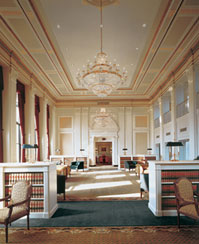
The move to The Fidelity Building (now 123 South Broad Street) was the highest risk alternative for the firm. Fidelity Bank had just merged with First Fidelity Bancorp (later First Union, then Wachovia and now Wells Fargo), and the bank was unsure of the role of the building in its plans and unsure of the amount of capital expenditures that it was prepared to make. Owning and leasing office buildings was not its business, and it was very uncertain at every stage as to how to proceed. It had determined at the senior level, however, that it wanted to conclude the MMW&R lease. In addition to having a substantial tenant, the bank saw the opportunity to shed some of its facility costs and to enhance its banking business with the firm in the building. Actual lease negotiations took months, and at times were very frustrating because of changing positions within the Bank.
Design and Construction in an Historic Building
Then came a whole new aspect of the project, design of the new offices and the relocation itself. We worked with MMW&R through the selection of the architects/space planners, consulting MEP engineers, general contractor and principal subcontractors, and the design of the new space itself, value engineering each component. We also developed a preliminary construction and relocation budget long before a new building was selected and long before the design of any space was concluded.
The almost $9,000,000 construction budget was structured with a tight relationship between the lease and the base building improvements that were the responsibility of the Landlord. These were further complicated by the historic character of this 1928 building. MMW&R required a new, modern HVAC system serving its space, and needed to replace many other outdated building systems. Furthermore, there were critical issues related to severe penalties for failure to vacate the existing space on time.
We evaluated each aspect of the relocation and construction, and after the lease was signed, still managed to save several hundred thousand dollars in construction and relocation costs.
On Time, Under Budget
The Partnership decision to relocate was made based on present value projections prepared by our firm. Each month thereafter we updated those projections for the firm. The final accounting after the building selection, lease negotiation and move-in showed less than a 1% variance from our initial projections for a fifteen year scenario, and that variance was due to additional furniture purchases by MMW&R.
Change in Building Ownership, MMW&R Lease Extension
The Bank, which occupied about half of 123 South Broad wanted to sell the building. To maximize the sale price, it created a two-unit condominium by separating the lower six floors that it occupied, including the retail space, into a separate unit, and selling each unit to separate buyers. MMW&R occupied the bulk of the upper floors known as Unit 2. MMW&R called REIS in to extend its lease.
Upon review, REIS realized that MMW&R did not have all of the protection that the original lease provided. For example, the original lease prevented the landlord from engaging in certain activities. Now, however, the landlord was the owner of Unit 2, and the building’s owner was the condominium association. To recover the original level of protections to MMW&R, the condominium association needed to enter into a tenant protective agreement ensuring that MMW&R would receive the benefits to which the lease entitled it. After a lengthy negotiation with the owner of Unit 2, REIS convinced it that such an agreement for all of its tenants was in its best interest too, especially as the creation of additional condominium units was possible. From identification of the issue to recording of the final agreement took nearly 1-1/2 years.
Following the recording, REIS negotiated a lease extension with the unit owner. An outline of terms was agreed to, at which point the owner of Unit 2 sold its interest and negotiations on the lease extension started anew with the buyer. This was successfully concluded, but in all, an extension of a lease took nearly two years.
Lease Overcharge
The lease extension contained a complex provision regarding additional rent. To make sure the new landlord understood and complied, REIS requested MMW&R to share recent rent bills for review. REIS discovered that indeed the landlord did not follow the new lease. Extensive negotiations followed with MMW&R receiving a substantial settlement.